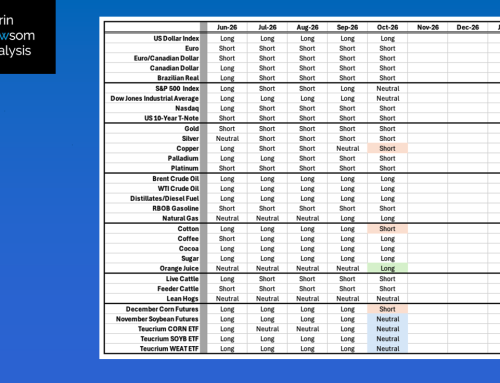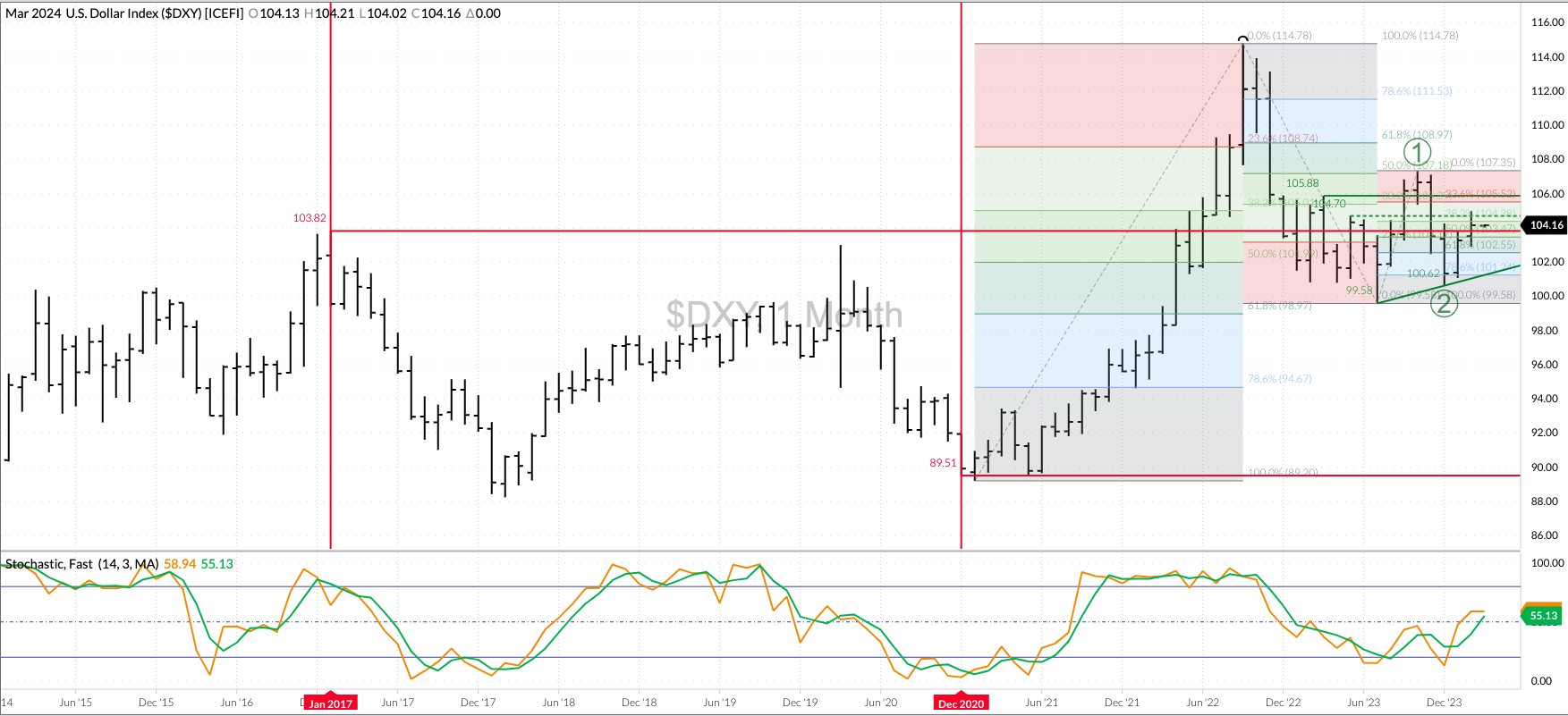


The US dollar index ($DXY): The $DXY remains in a major (long-term) 5-wave uptrend. The December low of 100.62 looks to be the bottom of Wave 2 (of a 5-wave pattern) meaning Wave 3 should take out the Wave 1 high of 107.35 (October 2023). Theoretical Positions: New long positions would’ve been established as the $DXY hit a new 4-month high this past September, roughly 104.70, with positions added as a new 2023 high was set near 105.90. This would create an average long of about 105.30, with a stop below the December low of 100.62.
The euro (^EURUSD): The euro remains in a major 3-wave downtrend with the December 2023 high of 1.11395 looking to be the Wave 7 (Wave B, second wave of the 3-wave pattern) peak. If so, then the euro would be expected to take out the Wave 6 low of 1.04487 (October 2023) with next downside targets at 1.04059 and 1.02007, the 50% and 61.8% retraecment levels respectively ely of the previous major uptrend from 0.93564 (September 2022) through the high of 1.12754 (July 2023). Theoretical Positions: Traders would’ve been stopped out of previous long positions from 0.98024 (close of September 2022) just below the previous 4-month low of 1.06354 for a gain of 0.0833. New short positions would’ve been established at the same price (1.06354) with sell stops above the 4-month high of 1.11395.
The euro/Canadian dollar (^EURCAD) I’ll say the major trend remains down after completing a bearish 2-month reversal at the end of May, though the monthly chart continues to show a sideways consolidation pattern. The rally seen during November could still be considered Wave B (second wave) of the 3-wave downtrend pattern. Theoretical Positions: Traders might’ve liquidated longs from the August 2022 close of 1.31904 near the May 2023 close of 1.45107 (a gain of 0.13203) and establish new short positions (short euro/long Canadian dollar). Stops would be placed above the Wave B high of 1.50448 (November 2023).
The Canadian dollar (^CADUSD) looks to be in a sideways trend, the range now between the 4-month high of 0.75883 (December 2023) and 4-month low of 0.71950 (November 2023). Theoretical Positions: Traders could be long from the October 2022 close of 0.73395 based on a bullish spike reversal. Additional longs might’ve been established near the March 2023 settlement of 0.73975, putting the average long near 0.73685. Also, additional longs may have been established during June as the loonie took out its previous 4-month high of 0.75398. If so, the average long position would now be 0.74256. If sells stops were triggered below the previous 4-month low of 0.73238 from May, then the average loss would’ve been 0.01018. Traders could look to play a breakout in either direction.
The Brazilian real (^BRLUSD) remains in a major sideways trend. Theoretical Positions: New long positions were established when the real took out its previous 4-month high of 0.20214 from February 2023, with additional longs established as the real took out the May high during June. This puts the average position at roughly 0.20346. It’s possible these positions were stopped out with the move to a new 4-month low during October. If not, stops would now be placed below the October low of 0.19165. Otherwise, traders might continue to sell options in a short strangle position using previous 4-month highs and lows as parameters.