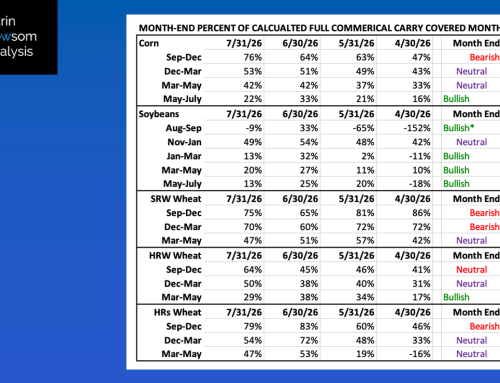
The bottom-line supply and demand number is stocks-to-use (s/u). I’ve long said stocks-to-use are the Readers’ Digest version of supply and demand, in that one number can tell us the bullishness, bearishness, or neutrality of a market’s fundamentals. I’ve also argued endlessly over the years with economists, my point being there should be a strong positive correlation between stocks-to-use and cash price. Given this premise, I’ve developed my system between the two for all three major markets (wheat, corn, and soybeans) with the r-squared[I]for all three near 100%. In all cases I’m using the cmdty National Cash Price Indexes (weighted national average cash prices from Barchart), and in wheat that means HRW, SRW, and HRS have been weighted to reflect US production of all wheat supplies. The Darin Newsom Analysis, Inc. (DNAI) stocks-to-use numbers are calculated at the end of every month, and then compared to the previous month and the previous year. The DNAI numbers may not agree with subsequent USDA report estimates, but that is understandable given the DNAI numbers are real (based on national average cash prices) rather than imaginary (based on…I have no idea).
WHEAT: The 2021-2022 combined daily average cash price for the three major wheat markets was $7.45 at the end of December, correlating to a s/u figure of 23.6%. The end of November showed s/u of 24.6% and the previous December 43.8%. As has been the case since August 2020, the all wheat s/u station continues to tighten with the average cash price increasing for the 16th consecutive month (see second chart on website). The fundamental reads of futures spreads and national average basis for the three wheat markets are generally in line with the end of December bullish s/u calculation. Only the cmdty National SRW Wheat Basis Index (weighted national average) could be considered bearish as it continues to run below its previous 5-year lows.
CORN: The 2021-2022 daily average of the NCPI though the end of December was calculated at $5.42, another solid increase from the November average of $5.28. This put my end of December s/u calculation at 9.4% as compared to last month’s 9.8% and last December’s calculation of 12.1%. It’s interesting to note with the first month of 2021-2022 Q2 in the books available corn s/u has now fallen below the 9.6% calculation at the end of 2021-2022 (see third chart on website). While we have no idea what was harvested last fall (and still won’t after the next round of USDA Supply and Demand reports), we can assume bushels have been locked up tight for the spring and early summer. The idea the US could see a seasonal increase in bushels during January was being discussed at the end of December, putting the spotlight on national average basis and cash prices this month.
SOYBEANS: The 2021-2022 daily average of the NSPI though the end of December was calculated at $12.23, correlating to an end of month available s/u of 0.3%. This is a decrease from last month’s s/u calculation of 0.4% tied to the average cash price of $12.10 (see fourth chart on website). The bottom line is available US supplies continue to tighten in relation to demand, with much of what we saw during December coming from domestic crush. It will be interesting to see if the next round of “official” monthly crush numbers show the same conclusion. Export shipments were roughly 290 mb for the month, though Thursday, December 23. November saw shipments reported at 374 mb.
[i] R-squared is defined as “a statistical measure of fit that indicates how much variation of a dependent variable is explained by the independent variable in a regression model.” (Investopedia). In my world, it is how closely related two (or more) variables are, in this case national average cash price and stocks-to-use.