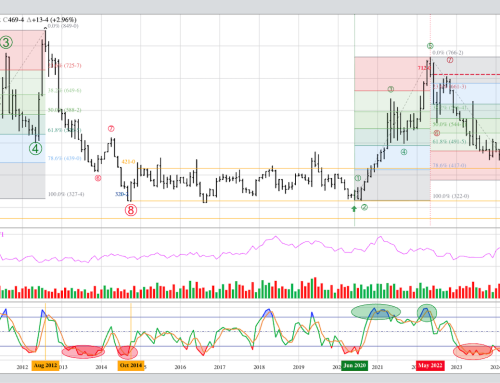
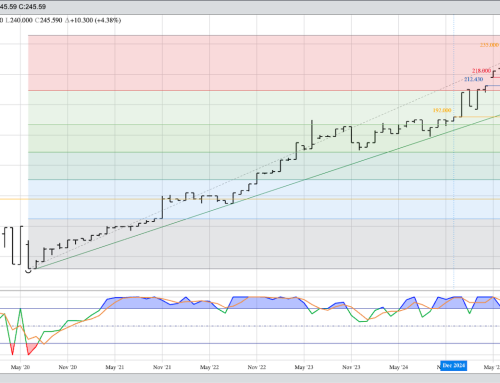
January was quite a month. I won’t go so far as to call it “extraordinary” because much of what we saw has become “ordinary”. Still, the commonness of the events, they have upped the volatility in a number of key investment markets in the commodity complex. If we just look at the Three Kings of Commodities – Gold, Crude Oil, and Corn – we see important market moves were made last month, moves that could influence investor behaviour over the course of 2026 and beyond. Yes, there was, is, and will continue to be a common thread to all this, something or someone that won’t be going away any time soon. If ever. What I mean by this is the United States has thrown away not only 275 years of history as the great experiment in democracy, according to Washington and Franklin, but has seen its Constitution burned on the fire of authoritarianism as well. Was it worth it? According to one person I talked to, at least the US knows who is supposed to use what bathroom. I kid you not. I mention this because what is happening has played an important role in our investment positions.
Let’s start with Crude Oil. On January 3, 2026, the US invaded Venezuela as part of “Operation Absolute Resolve”, with the US administration using the Monroe Doctrine as justification. This has long been a controversial piece of US foreign policy as it basically states the Western Hemisphere belongs to the United States. And while the discussion around the Monroe Doctrine ebbed and flowed early in the month, the underlying reality of the invasion was clear: The US president wanted Venezuela’s oil. After all, his role model, Russia’s Putin, Vlad the Invader himself, took over the crude oil industry in his country and made a few rubles in the process. And if Vlad can do it, well, that’s all the excuse the US president needed.
If we set aside our feelings of moral outrage at what is happening and look at the market strictly from an investment point of view, some of the money being made in the ongoing long-term uptrends of US stock markets could be rolled into the WTI crude oil market. Yes, supplies are expected to increase over time while the evolution of the energy sector at large leads to decreased demand. But we know the US president will do anything and everything to raise the price of oil, now that he has declared himself president of Venezuela, including more threats about using military force in Iran. Given all this, it was not surprising the futures market posted a strong rally las month, but was it enough to break the long-term downtrend? Time will tell.
Then on January 12, the US administration turned its sights on Corn. For some background, the US president has said the high price of food hurt his regimes showing in the 2025 election cycle, and with mid-term elections coming up in 2026 he announced a decree that prices will be lowered. In the cattle and beef market this meant USDA would fabricate lower daily boxed beef prices, despite evidence showing beef at the counter was still going up in price. But there was a more important market to take down: Corn. I’ve talked about the Domino Effect in US agriculture in the past. If one wants to collapse the industry, it has to start with corn.
Given so much of the industry lives and dies with each imaginary number released by USDA, the simplest way to wreck the market is through World Agriculture Supply and Demand Estimate reports, or WASDE for short. It’s also well known that in terms of hype, the January round of WASDE is equal to the Super Bowl, Daytona 500, and Kentucky Derby combined. Therefore, all USDA had to do was release some ludicrous numbers and the corn market was reset at a lower price level. We saw the National Corn Index fall out of its range between roughly $3.90 and $4.10 to a low near $3.80. The March futures contract was between approximately $4.55 and $4.35 before falling to nearly $4.15. But as I talked about in my Column “The Facts About Corn”, the market’s real supply and demand situation was still leaning bullish. As of this writing on February 1, 2026, my thoughts on being long the Dec26 futures contract, or Teucrium CORN fund long-term have not changed. I still like the position based on the longer-term May-July futures spread and looking out at the 2026-2027 forward curve.
Amidst all the insanity, and I don’t care what anyone calls it, insane it is, Gold continued to rally on safe-haven buying from investors and central banks around the world. Until it didn’t. January came to an end with the Gold Cash Index falling as much as $675 before closing near $4,892, down $479 (8.9%) for the day. Despite the meltdown, the Index still closed $567 (13%) higher for the month. What do I read into the action from January 30? For now I view it, along with what happened in Silver, as clear examples of a Vacuum Trade, meaning both markets simply ran out of buy orders while investors took some end of month gains off the table.
But there was something else at play that day. The US president named his puppet of choice for the next Chairman of the US Federal Open Market Committee. There was some talk that this calmed the fears of the Fed’s loss of independence that was fostered by the administration’s unfounded criminal charges against the current Fed Chairman Jerome Powell. Mr. Powell’s crime? Not lowering interest rates as fast as the US president demanded. I’ve argued that the naming of the next Fed Chairman actually signals the end of the Fed’s independence meaning long-term investors should be back buying gold sooner rather than later.
Darin Newsom