The Law of Supply and Demand: Market Price is the point where the quantity demanded equals quantities available creating a market equilibrium. If we consider the three variables in the equation (Market Price = Supply, Demand) the only one known is Market Price. Therefore, a study of Market Price is all that is needed to understand the relationship between the unknown variables of Supply and Demand. For Market Price I’m using National Cash Indexes for the 5 major grain markets.
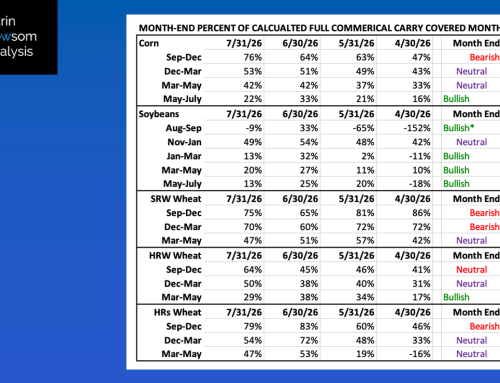
CORN: The National Corn Index was priced at $4.0191 at the end of December, as compared to end of November figure of $4.0189. The previous 5-year end of December low price was $4.3179 from 2024 with the 10-year end of December low at $3.1229 from 2016. The bottom line for the corn market is supplies remain large in relation, the most since 2019. This despite continued strength in export demand with the latest pace projection for the 2025-26 marketing year coming in at 4.653 billion bushels (bb), an increase of 71% from 2024-25’s reported shipments of 2.72 bb. The May-July futures spread closed the month covering a still bullish 30% calculated full commercial carry (slide 2) indicating the commercial side is still expecting supply and demand to tighten during planting season.
SOYBEANS: The National Soybean Index was priced at $9.6912 at the end of December, as compared to end of November figure of $10.6473. The previous 5-year end of December low price was $9.4559 from 2024 with the 10-year end of December low at $8.0099 from 2018. The bottom line for the soybean market is it continues to grow more bearish fundamentally. If not for a spike in both futures and the Index during November, driven by misinformation from the US administration, it is highly likely the Index would be well below its previous 5-year low end of December price like corn and the three wheat markets. The March-May futures spread closed December covering 49% calculated full commercial carry (slide 3) as compared to the end of November’s 29%. This tells us the commercial side has grown more confident of Brazil’s 2026 production potential, meaning less global demand for US supplies.
SRW WHEAT: The National SRW Wheat Index was priced at $4.5321 at the end of December, as compared to end of November figure of $4.7404. The previous 5-year end of December low price was $4.9270 from 2024 with the 10-year end of December low at $3.6055 from 2016. The bottom line for the SRW wheat market is supplies continue to outweigh demand, despite an uptick in 2025-2026 export demand. The latest update showed all US wheat on pace for shipments of 982 million bushels (mb), an increase of 27% from 2024-25’s reported shipments of 776 mb. As for SRW itself, total sales (total shipments plus unshipped sales) were up 8.5% for the marketing year. Looking out to new-crop, 2026-27 futures spreads continue to cover more calculated full commercial carry (slide 4) indicating the longer-term commercial view is growing more bearish.
HRW WHEAT: The National HRW Wheat Index was priced at $4.4406 at the end of December, as compared to end of November figure of $4.4812. The previous 5-year end of December low price was $4.9776 from 2024 with the 10-year end of December low at $3.1583 from 2016. The bottom line for the HRW wheat market is supplies continue to outweigh demand, despite an uptick in 2025-2026 export shipments. The latest update showed HRW total sales (total shipments plus unshipped sales) were up 85% for the marketing year, an incredible increase. Still, the Index set a new 5-year end of December low. Meanwhile, new-crop futures spreads covered more calculated full commercial carry (slide 5) than they did at the end of November indicating an increasingly bearish long-term commercial outlook.
HRS WHEAT: The National HRS Wheat Index was priced at $5.5633 at the end of December, as compared to end of November figure of $5.5256. The previous 5-year end of December low price was $5.7636 from 2024 with the 10-year end of December low at $4.6676 from 2016. The bottom line for the HRS wheat market is supplies continue to outweigh demand. The latest weekly export sales and shipments update showed HRS total sales (total shipments plus unshipped sales) were down 8% for the marketing year.