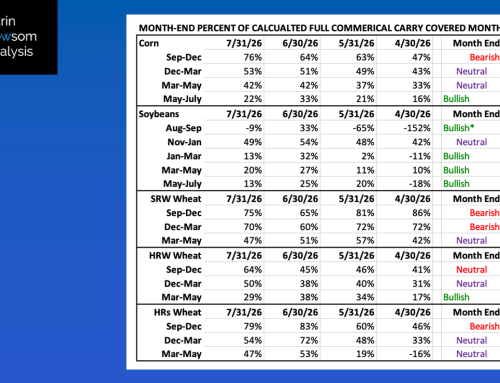
The bottom-line fundamental number is stocks-to-use. I’ve long said stocks-to-use is the Readers’ Digest version of supply and demand, in that this one number can tell us the bullishness, bearishness, or neutrality of a market’s fundamentals. I’ve also argued endlessly over the years with economists, my point being there should be a strong positive correlation between stocks-to-use and national average cash price (National Price Indexes). Given this premise, I’ve developed my system between the two for the five major markets (corn, soybeans, and three major wheat classes) with the r-squared[I]for all near 100%. Using this system I can pull data any day of the month, but by using the end of month number it gives us a picture of the available stocks-to-use (as/u) situation at month-end, a system that should smooth out the wide changes seen at the end of a marketing year. It also puts a spotlight on what I call the Marketing Year Misdirection, meaning supply and demand is a constant flow rather than a hard line drawn between old-crop and new-crop.
CORN: The National Corn Index (NCI) was calculated at $4.26 on May 31, 2024, a price that correlates to an end of month available stocks-to-use (as/u) of 12.4%. The end of April showed $4.24 and 12.5% with May 2023 coming in at $6.28 and 9.2%. The 2024 market continues to follow what was seen during 2014, with June setting up to be a critical month. A decade ago the NCI posted a high monthly close of $4.86 at the end of April before falling to a low monthly close of $2.84 at the end of September. The end of May 2014 saw the NCI priced at $4.43. On Friday, May 24 this year, the NCI was priced at $4.43 before falling to close out the month. Fundamentally, neither national average basis nor futures spreads appear to warrant a 2014 style selloff.
SOYBEANS: The National Soybean Index (NSI) was calculated at $11.43 on May 31, 2024, a price that correlates to an end of month available stocks-to-use (as/u) of 10.2%. The end of April showed $10.98 and 11.6% with May 2023 coming in at $12.74 and 7.2%. Demand seemed to heat up during May, and with exports still lagging the spotlight turns to domestic crush. As of Thursday, May 23, total export shipments were 1.455 bb, putting May shipments at only 45 mb and projecting 2024 export demand of 1.692 bb. If realized, this would be down 19% from last year’s reported shipments of 1.918 bb. We’ll get the April Crush number on Monday, June 3. Technically, the NSI still looks to be in a major (long-term) uptrend on its monthly chart.
SRW WHEAT: The National SRW Wheat Index (SWI) was calculated at $6.22 on May 31, 2024, a price that correlates to an end of month available stocks-to-use (as/u) of 37.0%. The end of April showed $5.38 and 41.8% with May 2023 coming in at $5.52 and 41.0%. The cash SRW wheat market remains interesting in that the SWI is indicating a tightening as/u situation while both national average basis and futures spreads remain bearish. In fact, the latter is in another Variable Storage Rate pricing period until Friday, June 21, with the daily average on Friday, May 31 coming in at roughly 78%. If the daily average is greater than 80% at the end of the calculation period the official storage rate is increased once again, to roughly 11 cents per bushel per month.
HRW WHEAT: The National HRW Wheat Index (HWI) was calculated at $6.82 on May 31, 2024, a price that correlates to an end of month available stocks-to-use (as/u) of 36.0%. The end of April showed $5.81 and 39.6% with May 2023 coming in at $7.57 and 31.7%. With the end of May theoretically marking the end of the 2023-2024 marketing year for wheat, the HRW market found itself near midrange for the past 20 years with the median as/u coming at 41%.
HRS WHEAT: The National HRS Wheat Index (HSI) was calculated at $7.00 on May 31, 2024, a price that correlates to an end of month available stocks-to-use (as/u) of 37.0%. The end of April showed $6.80 and 38% with May 2023 coming in at $7.48 and 35%. The spring wheat market took a back seat to winter wheat to close out the 2023-2024 marketing year. Still, the HSI found itself slightly tighter than the 20-year median as/u of 41%.
[i] R-squared is defined as “a statistical measure of fit that indicates how much variation of a dependent variable is explained by the independent variable in a regression model.” (Investopedia). In my world, it is how closely related two (or more) variables are, in this case national average cash price and stocks-to-use.